I watch a lot of talks on video and read a lot of articles. I want a place to say that I liked a thing, and what I picked up from it. And I wish I wasn’t the only one up to doing such things.
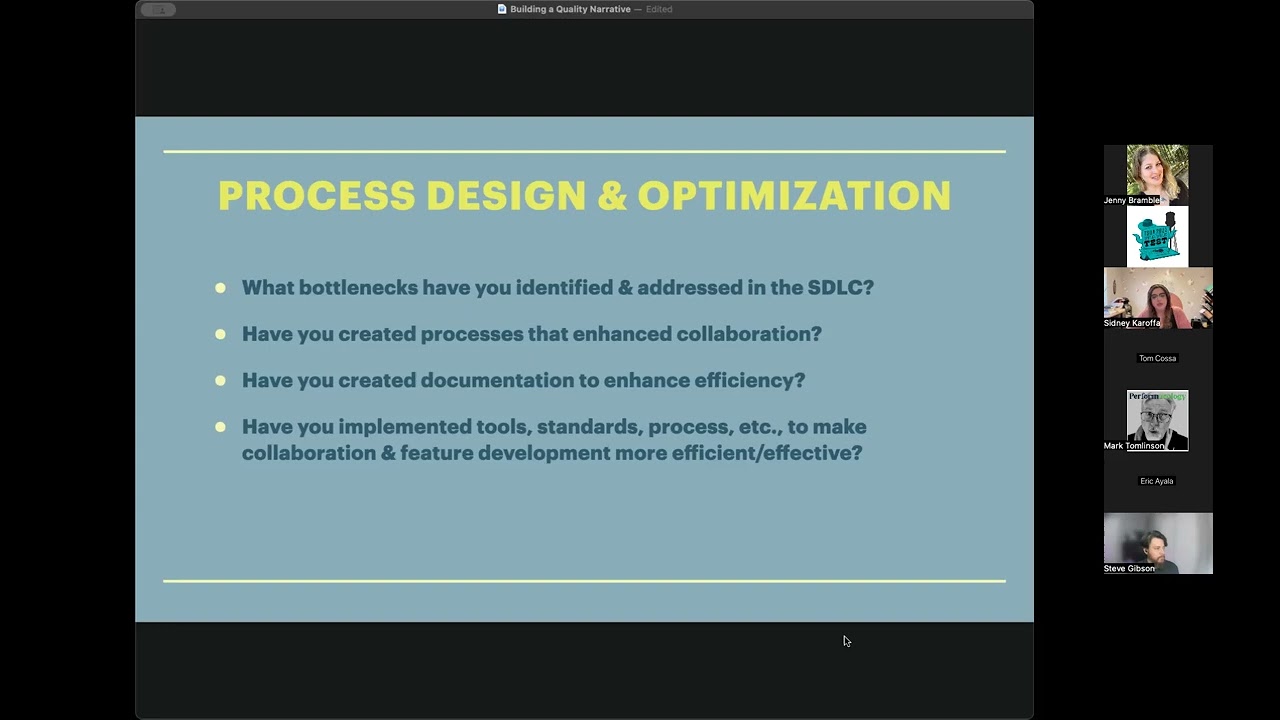
Let me start with a great 1st-time speaker talk: Sidney Karoffa on ‘Building a Quality Narrative’
TL;DR
Redundancy can make you realize how you explain your impact and value so that makes great examples of what testers do in the projects
Use impact-driven language and give specific examples of how your work contributes value. Stories with number, or like Sidney says it: qualitative and quantitative both.
Create your own framework to describe a balanced view, hers is 1) test architecture 2) process design & optimization and 3) product quality.
Right now I’m reading non-software related books. “Quiet” by Susan Cain is an interesting window into how modern life has given us a mind-shift towards always selling and never just letting the mind rest. To the point where natural introverts (many of them are software engineers) are forced by society to be more energetic, and gregarious than they might optimally be comfortable with. Most notably having to “sell themselves” in the job market in order to get hired for example. A constant push to reach higher, when often our own best is already inside of us, and just needs to be found.
I read many things today too, and this one was worth sharing:
TL;DR
when taking other people’s (test automation or whatever) codebases, always check for .vscode/tasks.json. Trusting a project executes what is there and that can do a lot even when the service chain tries to block it.
getting the homework repo deleted by GitHub as part of your take at home coding test is next level achievement
I can imagine that some check-in defensive agent must be filtering for this in CMakelists.txt as well, very interesting CI/CD problem to be looking out for at home too.
I’m working on a questioning framework that contains sets of general questions that I can quickly ask during a feature review meeting to qa manager and pm’s.
If the framework is developed as I had expected, I will share it with folks, and I will try to improve it.
What problem I’m trying to solve with it - so basically feature review meetings are hardly 30 min - 1hour and during those meeting most of the time, I spend my time thinking about feasible questions, which even drag the meeting. So with such questioning framework which may also work as a checklist I will try to solve one of my problem and save some time of myself as well as whole team.
I spend my time thinking about feasible questions, which even drag the meeting.
In one case, we just made a proposal to stop having test case review meetings since the value those create is low - before we tried supporting those with a checklist of questions and perspectives.
In another, we tried using shorter meeting as intro, then had a silent meeting part where we collected perspectives, and then another active conversations on the perspectives. Sometimes the silent part was overnight, we tried both an actual silent meeting and homework. Both worked better than having a meeting with a thinking-on-your-feet style supported with a framework.
The book I mentioned earlier, talks about cultures where meetings are viewed as toxic to productivity in the people they choose to employ. Even goes so far as to have a “no talking” day in the week, where nobody is allowed to speak. I’m keen to get a copy of iWoz , the Steve Wozniak book at some point. People will share only what needs sharing, and build great things anyway, but it does mean huge variations in productivity need to be expected, something our metrics culture rails against.
Today I watched (from tip by @racheljoi) ‘How to introduce yourself and get hired’. While TL;RD of 10 minutes feels unnecessary, I’ll give it anyway:
TL;DR: Introduce yourself in 20 words that tells what I can do for you in terms of benefit, breakthrough, or passion/strength/mission. Tell it so that people ask tell me more.
My reframe is that that people frame testing incorrectly a lot. What would my 20 word introduction of do that makes people go ‘tell me more’ on testing?
Research at one company noting three patterns of how work changes: task expansion, blurred boundaries between work vs. non-work, and more multitasking adding to sense of overwhelm from work
Loved how the concept of task expansion helps me discuss how we expect testers to be a mix of devops engineers, great at testing, fluent at automation as polyglot, and self-organized leading others on quality engineering. And how AI adds to that by encouraging the expansion.
Recommendations are structures protecting people in the organizations so that “starting yet another agent on lunch hour” would not become the norm that burns us out.