Someone tells you that testing isn’t needed!
How do you explain the fact that it is?
FYI: We’re using this to help us create foundational content for a course, so helpful responses are appreciated.
Someone tells you that testing isn’t needed!
How do you explain the fact that it is?
FYI: We’re using this to help us create foundational content for a course, so helpful responses are appreciated.
I just go for news articles where things have failed, particularly banking or finance. Something that affected a lot of people. Once they’ve listed the root cause, it doesn’t take much to explain how testing could have prevented the issue. In my field of performance testing, I often refer to Black Friday outages or challenges getting concert tickets.
Relating it to something they could have been affected by gives the audience something tangible. It’s even better if one of the people actually pipes up and says ‘yeah I couldn’t pay for my morning coffee that day’ or similar.
You could then go one further and do some maths to explain the cost of such outages, comparing the thousands of pounds/dollars of lost revenue vs the minimum wage pittance that the current testing market is forcing us to work on.
I could probably write a story after story about when it is and isn’t. I always come back to rewriting this post. 
Have a massive stage performance, like Eurovision, and say that rehearsals, checklists and contingency plans are not required.
If they mean “no testing at all”, some examples of drastic failures are a good start.
Examples:
I agree with them. Qualified with:as long as you are willing to accept andn take responsibility for any critical or major bugs that impact the company or clients business.
That usually works.
I suggest that person to fly with a Boeing these day.
There are bugs found by customers in production …
And I suggest this person should stop complaining about bugs of other products.
They are customers too.
Of course, testing is not “needed”:
Testing is only necessary if you want to know what the software does. So if you don’t need to know what it does, and you just want to assume that it works after it has been built, you can go right ahead.
But here are some examples of what can happen if you don’t know what your software does:
The value of software testing is, at the least, in its capability of identifying risks that may cause problems, even if you never do anything with the information.
Telling someone why testing is needed already got a lot of examples. Additionally, I’d probably point out how someone would make a confident decision if something can be shipped to a customer without it. Going along with Paul Gerrard here: What is the Value of Testing?
I’d adapt my reaction based on several factors, like:
I had this statement in a variety of forms.
I usually tend to agree with them as most see it objectively.
Why would I explain if it is really a case where testing is not needed?
L’ordinateur d’Ariane
Some bugs can be costly. Some costly bugs are more costly than others.
A challenge for this statement:
Those arguments are all perfectly legitimate until they are not. Once can only imagine some of those arguments might have been overused, at Fujitsu, for example. Ultimately, we don’t test to help make the product perfect. Rather, we test to help make the product closer to perfect than it would have been if not tested. Ultimately, someone (e.g., the product owner) must make the call as to when the product is deemed good enough.
A rocket falling out of the sky is very costly, BTW.
Software testing ensures reliability, security, and performance by identifying and helping to fix defects timely before users find them - saving time, money, mental health and reputation (and sometimes lives)
My general experience is: Give value and people will not challenge testing.
In a concrete project I just DO my testing and give my report (mostly vocally, directly to people, supported by a text) to relevant people.
Once they start discussing the points I raised is the question of what the value of testing is is forgotten.
(to report (activity) > report (artifact))
Isn’t that THE question we have heard so many times? Like from friends and family that have no clue what exactly we do (they think of pressing buttons on websites or apps is what we do…) 
The above stated comments are great, I did also ask ChatGPT and our company integrated GPT model and they have similar results, will share later
I suppose we all know the curve of Boehm.
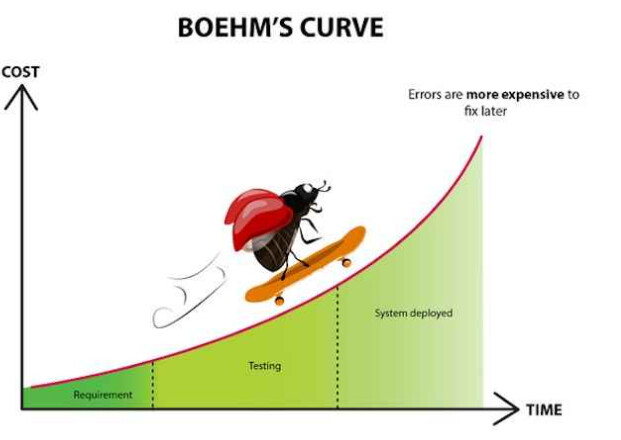
What also helps, is that when people say no testing is required or it’s useless. Tell them to write it on black/white, email it to you. Stating that they’ll take responsibility for it when it goes down in production. They don’t want to do that… so they have no way to counter you on that and if they do … well they’ll be responsible 
That’s a myth. Here’s only one article on the topic:
“The original project data, if any exist, are not more recent than 1981, and probably older; and could be as old as 1967,” said Bossavit, who also described “wanting to crawl into a hole when I encounter bullshit masquerading as empirical support for a claim, such as ‘defects cost more to fix the later you fix them’.”
Here is a 2016 paper [PDF] whose authors “examined 171 software projects conducted between 2006 and 2014,” all of which used a methodology called the Team Software Process. The researchers concluded that “the times to resolve issues at different times were usually not significantly different.” "
I have written some documents when I felt the need to explain the value a tester brings to the table - and even though a tester and testing is not equivalent, there is still a lot of overlap.
How a Game Tester adds value
And then I have also tried to explain why we actually need specialist testers, and that testing is an engineering discipline that adds value to the team.
Do we really need game testers?
Best regards,
Johan
I guess I would turn it around and ask how would you feel about something not being tested? (then would use examples that people are bound to care about and are likely to have used or been affected by)
For example: